- Why Standard Types of Brazing Fall Short in High-Stakes Applications
- Vacuum Brazing: The Gold Standard for High-Performance Alloys
- Induction Brazing: Precision Heat Where You Need It
- Honeycomb and Furnace Brazing
- Active Metal Brazing
- Selecting the Right Brazing Method for Your Application
- The Manufacturing Reality: Integration and Expertise
- Making the Right Choice for Your Components
- Frequently Asked Questions
Key Takeaways
- Vacuum brazing creates oxidation-free joints ideal for high-performance alloys like Titanium and Inconel, while induction brazing offers rapid, localized heating for complex components.
- Honeycomb furnace brazing enables lightweight aerospace structures through uniform heating, and active metal brazing bonds ceramics to metals for advanced applications.
- Selecting the right types of brazing depends on material compatibility, joint geometry, production volume, and certification requirements for defense and aerospace parts.
When you’re manufacturing components for aerospace and defense applications, the joining method you choose determines whether your part performs flawlessly at 40,000 feet or fails catastrophically under pressure.
Brazing stands apart from welding in one critical way: it joins metals without melting the base materials. Instead, you use a filler metal with a melting point above 450 °C (842 °F) that flows between precisely fitted surfaces, creating bonds that often exceed the strength of the parent materials themselves.
For the extreme environments your parts face in defense and aerospace, not all brazing methods deliver the performance you need.
Why Standard Types of Brazing Fall Short in High-Stakes Applications
Traditional torch brazing works fine for general industrial use. But when your components must handle extreme temperature swings from -65°F to 500°F, operate in vacuum conditions, or maintain strength under sustained G-forces, you need specialized techniques.
The challenge grows when you work with dissimilar materials.
Modern aerospace and defense systems increasingly require joining advanced alloys like Inconel and titanium, or even bonding ceramics to metals. These materials need brazing processes that provide:
- Oxidation-free environments to prevent contamination
- Precise temperature control to avoid distorting thin-walled structures
- Uniform heat distribution across complex geometries
- Repeatability that meets NADCAP certification standards
Four brazing methods consistently meet these requirements: vacuum brazing, induction brazing, honeycomb furnace brazing, and active metal brazing.
Vacuum Brazing: The Gold Standard for High-Performance Alloys
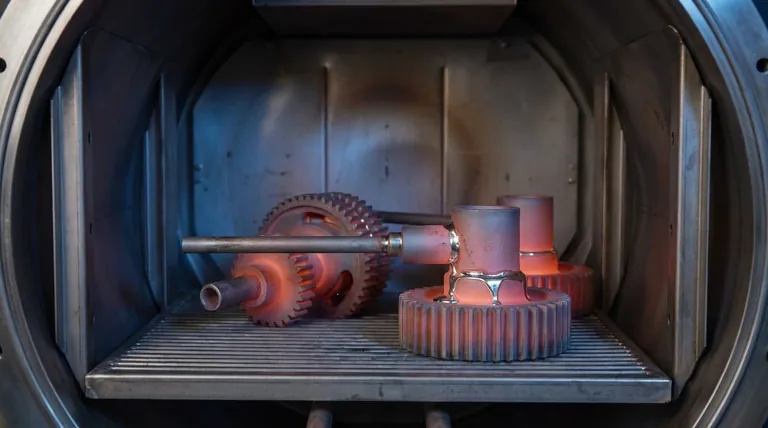
Vacuum brazing removes the atmosphere entirely.
You place your components in a vacuum furnace where pressure drops to near-zero levels. As temperatures rise to the brazing point, the lack of oxygen prevents oxidation completely. No flux required. No post-braze cleaning. No contamination.
This process works best when you’re joining reactive metals like Titanium and high-temperature alloys like Inconel. These materials oxidize quickly in normal atmospheric conditions, but vacuum brazing keeps surfaces clean throughout the joining process.
The results speak for themselves:
- Joint strengths that match or exceed base material properties
- Exceptional corrosion resistance
- Leak-tight seals capable of maintaining vacuum or pressure differentials
- Clean, oxide-free surfaces ready for immediate use
You’ll find vacuum brazing essential for turbine components, heat exchangers, and any assembly where internal cleanliness directly impacts performance. The process handles complex, multi-component assemblies in a single cycle, joining dozens of connections simultaneously with consistent quality.
When Vacuum Brazing Makes Sense for Your Application
Consider vacuum brazing when your specifications require absolute cleanliness and you’re working with high-performance alloys. The process needs significant investment in furnace equipment, but the payoff comes in superior joint quality and no secondary cleaning operations.
Batch processing makes vacuum brazing cost-effective for medium- to high-production volumes. You can braze multiple assemblies at once, maximizing furnace capacity and reducing per-part costs.

Induction Brazing: Precision Heat Where You Need It
Induction brazing takes a different approach.
Instead of heating an entire assembly in a furnace, you apply heat exactly where you need it using electromagnetic induction. An alternating current passes through a copper coil positioned near your joint area, creating a magnetic field that generates electrical currents in the metal itself.
These induced currents generate heat directly in the workpiece.
The benefits become clear when you’re joining components with different thermal masses or working with assemblies that include heat-sensitive elements. You heat only the joint area, leaving surrounding structures at lower temperatures and reducing thermal distortion.
Speed matters too. Induction heating reaches brazing temperature in seconds rather than the minutes or hours required for furnace processes. This rapid heating and cooling cycle reduces grain growth in the heat-affected zone, often creating stronger, more fatigue-resistant joints.
Applications Where Induction Types of Brazing Excel
You’ll see induction brazing shine in these scenarios:
- Small, localized joints on larger assemblies where furnace brazing would heat the entire structure
- Dissimilar material combinations needing precise temperature control to prevent melting the lower-temperature component
- High-volume production where cycle time directly impacts manufacturing costs
- Selective heating of specific areas while protecting nearby features or previously joined sections
The process works well for joining carbide cutting tools, attaching fittings to tubing, and assembling components with complex shapes where uniform furnace heating creates problems.
Repeatability reaches levels that meet the most demanding quality requirements. Once you set parameters for a specific joint design, you can reproduce identical results across thousands of parts with minimal variation.
Honeycomb and Furnace Brazing
Honeycomb structures represent one of aerospace engineering’s best solutions to the strength-to-weight challenge.
These thin-walled, cell-like structures provide exceptional stiffness and strength while minimizing mass. But joining honeycomb core to face sheets, or assembling multiple honeycomb sections into larger structures, requires specialized brazing techniques.
Honeycomb brazing typically happens in controlled atmosphere or vacuum furnaces. The process requires careful attention to thermal expansion rates, filler metal flow characteristics, and fixturing to maintain dimensional accuracy.
You’ll find this technique essential for fabricating:
- Turbine engine components where weight savings translate directly to fuel efficiency
- Fan blades and vane structures that must withstand extreme rotational forces
- Control surfaces and structural panels requiring high stiffness-to-weight ratios
- Heat shields and thermal management systems
The Technical Challenge of Uniform Heating
Honeycomb structures present unique thermal challenges. The thin walls heat and cool rapidly, while face sheets or attachment points may have significantly different thermal masses.
Successful honeycomb brazing needs precise furnace control to ensure uniform temperature distribution across the entire assembly. Temperature variations of even 10-20 °F can result in incomplete filler metal flow or distortion of the delicate core structure.
Modern vacuum furnaces address this through multiple heating zones, programmable thermal cycles, and sophisticated temperature monitoring. You can adjust heating and cooling rates to match the specific thermal characteristics of your assembly.
Active Metal Brazing
Some material combinations seem impossible to join.
Ceramics and metals have different atomic structures, thermal expansion coefficients, and surface chemistries. Traditional brazing relies on the filler metal wetting both surfaces, but molten metal simply won’t wet ceramic surfaces under normal conditions.
Active metal brazing solves this problem by incorporating reactive elements directly into the filler metal.
These active elements, typically titanium or zirconium, react with the ceramic surface during brazing to form a thin interfacial layer that the filler metal can wet. The result is a strong, hermetic bond between materials that conventional joining methods can’t connect.
Your applications for active metal brazing include:
- High-temperature sensors where ceramic insulators must connect to metal housings
- Vacuum tube and microwave components requiring ceramic-to-metal seals
- Rocket nozzles and combustion chamber components
- Advanced electronic packages where ceramic substrates attach to metal heat sinks
Process Requirements and Limitations
Active metal brazing requires even tighter process control than conventional vacuum brazing.
You must maintain extremely low oxygen levels to prevent oxidation of the reactive elements before they can bond with the ceramic. Surface preparation becomes critical, as any contamination on the ceramic can prevent proper wetting and bonding.
The process typically happens in high-vacuum furnaces with carefully controlled heating and cooling rates to manage thermal expansion mismatches between ceramic and metal components. Too-rapid cooling can create residual stresses that crack the ceramic or the braze joint itself.
Selecting the Right Brazing Method for Your Application
Your choice of brazing method depends on several interconnected factors.
Material compatibility comes first. Reactive metals like titanium and zirconium need vacuum brazing to prevent oxidation. Ceramic-to-metal joints require active metal brazing. Standard aerospace alloys may work with any of these methods, but vacuum or induction brazing typically delivers better results.
Joint geometry and component size influence your decision too. Large, complex assemblies with multiple joints benefit from vacuum or furnace brazing, where you can join everything at once. Smaller components or selective joints on larger assemblies often work better with induction brazing’s localized heating.
Production volume matters. The capital investment in vacuum furnace equipment makes sense for medium to high volumes or when joint quality requirements justify the cost. Induction brazing offers faster cycle times for high-volume production once you’ve set parameters.
Quality and Certification Requirements
Defense and aerospace applications require documented process control and repeatability.
NADCAP certification provides third-party verification that your brazing processes meet aerospace industry standards. The certification process checks equipment capability, process documentation, operator training, and quality control procedures.
When you work with a NADCAP-accredited brazing supplier, you gain confidence that processes remain under statistical control and produce consistent results. This matters when component failure could result in loss of mission or loss of life.
The Manufacturing Reality: Integration and Expertise
Successful brazing needs more than just selecting the right process.
You need proper joint design that accounts for filler metal flow characteristics and thermal expansion. Surface preparation must remove contaminants without adding new ones. Fixturing must maintain alignment throughout thermal cycling while allowing for expansion and contraction.
This is where integrated CNC manufacturing capability becomes valuable.
When your brazing supplier also handles CNC machining and metal fabrication, you eliminate coordination problems between multiple vendors. Design for manufacturability happens naturally when the team that will braze your parts also machines the joint interfaces and fabricates the components.
At NAMF, we’ve built this integration into our core capabilities. Our Fairfield, NJ facility combines precision fabrication and machining, metal forming, and specialized dip brazing under one roof. When you need a ruggedized enclosure or complex assemblies for defense and aerospace applications, you work with one team that understands how each manufacturing step affects the final result.
Our NADCAP, NAVSEA, and ISO accreditations demonstrate our commitment to alodine coating standards, process control, and quality. But the real advantage comes from decades of experience solving specific joining challenges for components that must perform in harsh environments.
Looking Forward
Brazing technology keeps advancing.
New filler metal alloys expand the range of materials you can join and the service temperatures joints can handle. Improved furnace controls enable tighter temperature uniformity and more complex thermal cycles. Advanced modeling software helps predict filler metal flow and optimize joint designs before you build the first prototype.
Automation plays a growing role in high-volume brazing operations. Robotic part loading, automated atmosphere control, and real-time process monitoring reduce variability and improve consistency.
But fundamental principles remain constant. You still need clean surfaces, proper joint clearances, compatible materials, and controlled heating cycles. The physics of capillary flow and interfacial bonding don’t change, even as the tools for controlling them improve.
Making the Right Choice for Your Components
When your components face extreme temperatures, high-stress levels, or mission-critical reliability requirements, brazing method selection becomes a strategic decision rather than a simple process choice.
Vacuum brazing delivers unmatched joint cleanliness and strength for high-performance alloys. Induction brazing provides precision and speed for localized joints. Honeycomb furnace brazing enables lightweight structural assemblies. Active metal brazing opens possibilities for ceramic-metal combinations.
The right choice depends on your specific needs: materials, geometry, production volume, and performance specifications.
If you’re developing components for defense or aerospace applications and need guidance on brazing method selection, NAMF brings over 40 years of specialized experience. Our engineering team can assess your design, recommend appropriate processes, and deliver finished assemblies ready for integration into your production line.
Our expertise in military machining and military fabrication ensures your components meet the strictest defense standards. We specialize in military enclosures and complex assemblies that must perform flawlessly in the most demanding environments.
Ready to Discuss Your Brazing Requirements?
Partner with NAMF’s team of brazing experts to ensure your defense and aerospace components meet the highest standards. Our integrated manufacturing capabilities deliver precision-brazed assemblies ready for immediate deployment.