- What Makes Military Manufacturing Different from Commercial Production?
- How Do ITAR, EAR, and CMMC Shape Military Manufacturing Requirements?
- What Does DFARS-Compliant Material Sourcing Require?
- How Does AS9100D Differ from ISO 9001 in Defense Manufacturing?
- 5 Core Phases of Military Manufacturing
- Specialized Fabrication Techniques That Military Manufacturing Requires
- Biggest Supply Chain Risks in Military Manufacturing
- How Do You Build a Procurement Vetting Checklist for Defense Subcontractors?
- How to Choose the Right Military Manufacturing Partner
- The True Cost of Getting Military Manufacturing Wrong
- Frequently Asked Questions
Key Takeaways
- Sub-tier supply chain vulnerabilities are the leading driver of part failure and elevated Cost of Poor Quality in defense programs.
- ITAR compliance must be paired with documented cybersecurity controls to legally protect Controlled Unclassified Information from unauthorized access or export.
- AS9100D certification is the minimum quality threshold for defense work, adding counterfeit part prevention and risk management layers that ISO 9001 alone cannot provide.
Prime defense contractors and Tier-1 procurement teams operate under scrutiny that commercial manufacturers never face. When a component fails in the field, it rarely traces back to a fundamental flaw in the prime contractor’s core design. More often, it traces to a non-conformance buried deep in the sub-tier supply chain: a machined tolerance that drifted out of spec, an improper braze joint, or a counterfeit raw material that passed an inadequate receiving inspection.
Military manufacturing is not simply about cutting metal to tight tolerances. It is an end-to-end discipline of risk mitigation, regulatory compliance, and precision execution where a single gap in any production phase can compromise an entire program. For procurement officers and engineers evaluating aerospace and defense fabrication partners, understanding how each phase works is essential to making sound sourcing decisions.
This guide covers the full landscape of military manufacturing: what separates it from commercial production, what compliance frameworks govern every phase, how each production step works, what specialized fabrication techniques are required, and how to select a partner capable of delivering truly mission-ready components.
What Makes Military Manufacturing Different from Commercial Production?
Military manufacturing differs from commercial production because it requires 100% part conformance, complete material traceability, and strict regulatory compliance at every production stage, not just at final inspection.
Commercial off-the-shelf (COTS) components are designed and produced for predictable, controlled operating environments. Defense components are engineered to survive the opposite: extreme thermal cycling, severe shock and vibration loading, chemical exposure, and highly corrosive atmospheric conditions. In this sector, a component that is close to specification is not an acceptable component. It is a liability.
The American Society for Quality (ASQ) highlights that the Cost of Poor Quality (COPQ) can severely impact an organization’s bottom line. In military manufacturing, COPQ translates directly to compromised mission readiness and, in the most serious cases, endangered lives. Generic commercial job shops simply cannot meet these demands. A facility accustomed to producing commercial automotive or consumer goods lacks the administrative infrastructure to manage defense-grade documentation, material lot traceability requirements, or the rigid structure of First Article Inspections (FAI).
What Are the Four Non-Negotiable Requirements of Military Manufacturing?
Four requirements define military manufacturing and set it apart from commercial production:
- Regulatory compliance: Every process must adhere to applicable military standards, including MIL-SPEC, AS9100D, ITAR, and DFARS. Commercial equivalents do not satisfy these requirements.
- Complete material traceability: Every piece of metal must be tracked from the source mill certificate through every subsequent manufacturing operation to the final inspection record.
- Zero-defect conformance: Acceptance of nonconforming material is not an option. Every delivered component must fully conform to engineering specifications.
- Documented chain of custody: Every operation, verification, and handoff must be recorded, certified, and auditable at any point in the program lifecycle.
When a manufacturing partner cannot demonstrate all four requirements across their operations, they represent unacceptable program risk, regardless of price or quoted lead time.
How Do ITAR, EAR, and CMMC Shape Military Manufacturing Requirements?
ITAR, EAR, and CMMC together create strict legal, physical, and digital security requirements that govern every aspect of military manufacturing, from how blueprints are stored to how finished hardware is shipped.
The International Traffic in Arms Regulations (ITAR) strictly govern the export and transfer of defense articles and services. A compliant vendor must hold active registration with the Directorate of Defense Trade Controls (DDTC). But true compliance goes far beyond a registration number.
How a machine shop handles digital prints, CAD files, and Controlled Unclassified Information (CUI) is just as critical as how it cuts metal. The intersection of manufacturing and cybersecurity is increasingly regulated through the Cybersecurity Maturity Model Certification (CMMC) and NIST SP 800-171. If a subcontractor stores mil-spec blueprints on an unsecured, unencrypted server, they represent a massive vulnerability, regardless of their machining capabilities.
For prime contractors, sourcing from a non-compliant vendor creates liability far beyond scrapped parts. It risks ITAR violations, significant federal penalties, and immediate contract termination.
What Does ITAR Compliance Actually Require at the Facility Level?
ITAR compliance at the facility level means documented physical controls that restrict access to controlled technical data, background-checked personnel authorized to handle CUI, secure digital infrastructure that prevents unauthorized access or export of restricted information. It also involves regular internal audits to verify that controls remain in place and current.
A facility without active DDTC registration is not legally permitted to view, handle, or process drawings classified as ITAR-controlled. Procurement teams must verify current registration status before sharing any controlled technical data with a prospective vendor.
How Does CMMC Affect Defense Manufacturing Subcontractors?
The DoD’s transition toward CMMC means vendors must now prove their digital infrastructure can protect CUI at the level required by their program contracts. This is a relatively recent evolution in military manufacturing qualification, and many smaller fabricators are still working toward compliance.
Procurement teams must verify a vendor’s current CMMC posture and not only their physical security measures before qualifying them for any program involving controlled technical data. A vendor’s CMMC level must match the requirements specified in the program contract’s data security clauses.
What Does DFARS-Compliant Material Sourcing Require?
DFARS (Defense Federal Acquisition Regulation Supplement) mandates that specialty metals used in defense applications be melted or produced in the United States or a qualifying allied country. This is a strict legal requirement rooted in the Berry Amendment and related national security legislation, not a procurement preference.
On the shop floor, DFARS compliance means meticulous heat-lot tracking and raw material segregation from the moment metal arrives at the receiving dock. A qualified defense manufacturing partner physically and administratively isolates DFARS-compliant materials to prevent cross-contamination with commercial-grade metals, ensuring the traceability that standard industrial shops are not equipped to provide.
What Materials Fall Under DFARS Specialty Metal Requirements?
DFARS requirements apply to the metals most commonly used in defense and aerospace programs:
- High-strength titanium alloys, including Ti-6Al-4V, for aerospace structural components
- Military-grade aluminum alloys such as 7075-T6 and 6061-T6
- Nickel-based superalloys such as Inconel for extreme-temperature applications
- Specialized stainless steels for high-corrosion environments
- Copper-based alloys for electrical and thermal management components in military electronics
Every batch must be documented with Material Test Reports (MTRs) confirming exact chemical composition and mechanical properties before production begins. Receiving a certificate is not enough. The data on that certificate must be verified against the engineering specification before the first cut is made.
How Is Raw Material Traceability Maintained Through Production?
Traceability in military manufacturing is a continuous discipline, not a single intake check. Lot numbers, heat numbers, and MTR documentation must remain attached to the material from receipt through final inspection. Every physical transformation of the raw material must stay traceable to its source mill certificate throughout the entire production lifecycle.
For procurement teams reviewing vendor qualifications, one question cuts through the noise. Can your manufacturing partner produce an unbroken chain of documentation from the mill certificate to the final inspection report? Any gap in that chain represents supply chain risk that will surface during an audit or a program review, always at the worst possible time.
How Does AS9100D Differ from ISO 9001 in Defense Manufacturing?
AS9100D is the quality management standard built specifically for aviation, space, and defense production. It extends ISO 9001:2015 with requirements specific to the risk profile of this sector and replaces reactive quality checks with continuous, proactive auditing at every production stage.
In commercial manufacturing, a quality check often means measuring a finished part against a drawing before it ships. Under AS9100D, every nonconformance triggers a formal root cause analysis, rigid preventive actions, and comprehensive documentation to ensure the issue never repeats. This distinction is significant for procurement teams evaluating supplier quality systems.
AS9100D mandates several defense-specific controls that ISO 9001 does not require:
- Strict counterfeit parts prevention: Documented incoming inspection procedures to identify and quarantine non-genuine materials
- Unbroken lot traceability: From raw material mill certificate to the final shipped component
- Configuration management: Formal controls to manage engineering changes without producing nonconforming material
- First Article Inspection (FAI) requirements: Verification that the manufacturing process produces parts conforming to all engineering specifications before full production begins
- Advanced product quality planning: Proactive risk management integrated into the production planning process
Procurement professionals should look beyond the AS9100D certificate itself. The operational maturity of the quality system is what determines actual program risk. Ask vendors directly how nonconformances are documented, root-caused, and closed, and how engineering changes are controlled in the production traveler. The answers reveal the true depth of the system.
5 Core Phases of Military Manufacturing
Military manufacturing follows a sequential production chain where every phase builds directly on the last. A failure at any point compromises the integrity of the entire component downstream.
Phase 1: DFARS-Compliant Raw Material Sourcing and Verification
This is the first and most critical control point in the defense supply chain. Every physical transformation of the raw material must remain traceable to its source mill certificate throughout the entire production lifecycle. Any gap in that documentation chain represents supply chain risk that will surface during audits or government surveillance visits at the worst possible time.
A capable military manufacturing partner tracks every lot, batch, heat treatment, and finishing step throughout production. If a material defect surfaces years after deployment, the exact origin of the raw material must be identifiable and isolatable. Standard commercial shops often mix material batches and discard original mill certificates. In defense, losing a mill cert renders the part unusable, regardless of how precisely it was machined.
Phase 2: Precision Machining and CNC Operations
Once DFARS-compliant materials are validated and documented, production moves to the machining environment. This is where custom machining services become essential. Translating complex 3D CAD files and engineering drawings with geometric dimensioning and tolerancing (GD&T) callouts into physical metal components requires advanced equipment, qualified personnel, and documented process control at every step.
CNC milling is one of the most widely used methods in defense machining. High-speed vertical and horizontal milling centers allow manufacturers to hold tight tolerances on complex geometries while meeting the throughput demands of large defense programs. Five-axis CNC milling is particularly critical for defense structural components because it allows manufacturers to complete complex geometries in fewer setups, directly reducing fixturing error accumulation and improving overall dimensional accuracy.
For aluminum components, precision CNC machining can hold tolerances as tight as ±0.0001 inches (2.54 µm) across full production runs. This is a standard that manual operations simply cannot achieve reliably on anything beyond single-piece work.
Military machining programs frequently involve components with complex geometric profiles, deep pockets, thin walls, and multiple critical reference dimensions that must each be independently verified during in-process inspection. These requirements demand equipment and operator qualifications that are substantively different from commercial contract machining environments.
Phase 3: Military Fabrication, Defense Welding, and Specialized Joining
Military fabrication encompasses the forming, joining, and assembly operations that transform individually machined components into cohesive defense assemblies. This phase is among the most compliance-intensive in the entire production chain.
Defense welding is governed primarily by AWS D17.1, the specification for aerospace fusion welding. This standard establishes qualification requirements for welding procedures, operator certifications, inspection protocols, and acceptance criteria that are significantly more stringent than the commercial welding codes most fabricators operate under. A welder certified on carbon steel for commercial fabrication is not qualified to weld titanium aerospace structures under AWS D17.1. The qualifications are separate, process-specific, and material-specific, and each must be independently verified before any defense work begins.
Beyond fusion welding, many defense assemblies rely on dip brazing as a precision joining method. Aluminum assemblies are submerged in a molten salt bath that bonds multiple joints simultaneously, producing joints that are often stronger than the parent material with no flux residue and hermetic seal integrity measurable to quantified helium-equivalent leak rate standards. Dip brazing is the preferred method for RF waveguides, ruggedized electronics enclosures, and aerospace heat exchangers where standard welding cannot achieve the required structural and EMI shielding performance.
Non-destructive testing (NDT) is mandatory for all defense-welded assemblies. Methods applied include dye penetrant inspection (DPI), radiographic testing (RT), ultrasonic testing (UT), and helium leak testing for hermetically sealed components.
Phase 4: Precision Sheet Metal Fabrication and Forming
Precision sheet metal fabrication covers cutting, forming, punching, and joining metal sheets to exact dimensional specifications. In military manufacturing, this is not general commercial sheet metal work. Every step demands consistent dimensional accuracy, material traceability, and documented process control. Sheet metal fabricators serving defense programs must hold active certifications and operate under quality systems that match the compliance requirements of the programs they support.
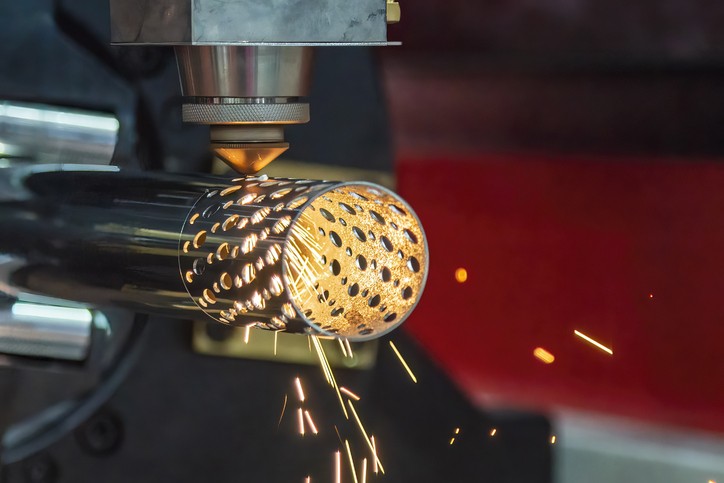
Aluminum laser cutting has become the production standard for cutting reflective metals in defense applications. Fiber laser systems produce parts with tolerances as tight as 0.003 mm at speeds four to five times faster than older CO₂ systems, with significantly less material waste. The precision of fiber laser cutting integrates seamlessly with downstream processes like CNC milling, press brake forming, certified welding, and MIL-SPEC surface treatments. This makes it possible to manage the entire production chain for an aluminum defense component without introducing quality risk at the transition between processes.
CNC punching adds dimensional control for complex hole patterns, high-volume production runs, and specialized forming operations. Combined with AWS-certified welding, these capabilities form the foundation of a compliant precision sheet metal fabrication operation in the defense sector.
Phase 5: MIL-SPEC Coatings and Surface Finishing
A fully machined and welded part is still not a finished defense component. Raw metal exposed to military operational environments, including salt spray, high humidity, chemical solvents, UV radiation, and thermal cycling, will degrade rapidly without the correct surface treatment.
MIL-SPEC coatings are mandatory surface treatments that protect finished defense components from these conditions. The most common specification for aluminum components is MIL-DTL-5541, covering chromate conversion coating (Type I) and non-chromate alternatives (Type II). These coatings serve three simultaneous functions: corrosion resistance against oxidation and chemical exposure, adhesion promotion for paint and primer systems, and maintenance of electrical conductivity required for EMI/RFI shielding on defense electronics assemblies.
Beyond chemical conversion coatings, defense programs frequently specify Type III hard anodizing for wear resistance on aluminum components subject to abrasion, electroless nickel plating for combined corrosion and wear resistance with tight post-coating dimensional control. They also specify conformal coatings for electronic subassemblies in high-humidity or chemical environments. They also specify low-observable finishes that minimize optical signature for field-deployed assets.
Specialized Fabrication Techniques That Military Manufacturing Requires
Military hardware operates in the harshest environments on earth. Specialized fabrication capabilities that go well beyond standard commercial work are required to produce components that perform reliably under these conditions.
How Are Military Enclosures Fabricated to Spec?
Military enclosures protecting sensitive electronics must simultaneously satisfy mechanical, environmental, thermal, and electromagnetic compatibility requirements. They must survive the shock, vibration, and thermal extremes defined in MIL-STD-810, and many require compliance with MIL-STD-461 for electromagnetic compatibility.
Producing a conformant military enclosure demands coordinated execution across multiple disciplines: precision CNC milling for enclosure bodies and mating surfaces, certified defense welding for structural joints requiring full-penetration welds, dip brazing for hermetically sealed joints and RF waveguide assemblies, and MIL-SPEC surface finishing for corrosion protection and EMI continuity. When all of these processes operate under a single quality system in a single facility, program lead time, traceability, and documentation management become substantially more efficient and far less prone to supplier coordination failures.
What Role Does Metal Fabrication Play Across Defense Programs?
Metal fabrication in defense programs spans sheet metal forming, structural welding, precision machining, casting, and specialized joining. What distinguishes defense metal fabrication from commercial work is not just the process technology; it is the compliance infrastructure surrounding every operation.
Every fabrication step must be documented. Every dimensional check must be logged against calibrated equipment. Every operator must hold qualifications for the specific process and material combination they are performing. In defense, metal fabrication is as much a documentation discipline as it is a manufacturing discipline, and vendors who treat it otherwise introduce risk into every program they touch.
How Does Precision CNC Machining Support Defense Programs?
No two defense programs call for identical components. Weapons systems and aerospace components require micro-tolerances that leave no room for thermal expansion errors or tool deflection during milling. Vendors must demonstrate the ability to hold tight tolerances consistently across large production runs, ensuring that replacement parts fit perfectly in the field without secondary modification or rework.
Advanced five-axis milling and turning centers allow manufacturers to machine complex aerospace geometries with fewer setups, which directly improves overall dimensional accuracy. For complex defense components, five-axis capability is a baseline production requirement, not an optional upgrade.
Biggest Supply Chain Risks in Military Manufacturing
Supply chain vulnerabilities in military manufacturing are well-documented and persistent. Understanding them helps procurement teams ask better qualification questions before a program starts and before risk becomes consequence.
How Does Supply Chain Fragmentation Create Compliance Exposure?
Fragmented supply chains are the most pervasive risk in military manufacturing. When a single component moves through multiple vendors for machining, welding, NDT, and finishing, the probability of a traceability gap increases at every handoff.
Lost lot numbers, undocumented handling events, and documentation failures between facilities operating under separate quality systems are common in fragmented supply chains. These issues typically surface during program audits or government surveillance visits at the worst possible time.
Every inter-facility transfer also creates a physical risk event. Precision-machined surfaces can be contaminated, scratched, or otherwise compromised in transit. Sensitive coating chemistry can be disrupted by improper packaging or environmental exposure during shipping. These are recurring quality escape sources in programs that rely on fragmented vendor structures, not hypothetical concerns.
What Happens When Engineering Changes Are Not Properly Controlled?
Defense programs routinely issue engineering changes after production has started. Managing those changes without producing nonconforming material or creating documentation gaps requires a formal engineering change control process directly integrated with the production traveler and quality records.
Vendors without this integration create program risk with every change notice they receive. Without a reliable mechanism to prevent the previous drawing revision from being built after a change is issued, the same nonconformance can repeat across an entire production lot before it is caught.
Why Is Counterfeit Parts Prevention a Critical Priority in Defense?
Counterfeit and substandard components in the defense supply chain are a well-documented, ongoing threat. Non-compliant fasteners, fraudulently represented raw materials, and counterfeit electronic components have all been identified in active defense programs, with serious operational and legal consequences.
DFARS-compliant sourcing combined with rigorous incoming inspection and MTR verification are the primary controls available. They only work when applied consistently across every procurement action, without exception.
How Do You Build a Procurement Vetting Checklist for Defense Subcontractors?
Moving beyond a capabilities presentation requires digging into the operational realities of the shop floor. These criteria should be evaluated during any defense subcontractor qualification:
Evaluate Facility Capacity and Single-Source Dependencies
Assess whether the shop floor is designed for efficient workflow or whether it has identifiable production bottlenecks. Identify single-source dependencies on specific machines or personnel that could jeopardize delivery schedules during high-demand periods or machine downtime events. Review equipment calibration records; machines operating without current calibration documentation are a direct indicator of quality system immaturity, regardless of what certifications are displayed.
Review First Article Inspection Protocols and Corrective Action Records
Review the vendor’s internal FAI reports and their documented protocols for corrective and preventive actions. A capable quality department catches non-conformances before parts reach the shipping dock, not after they arrive at a customer’s receiving inspection.
Ask specifically: how many open corrective actions does the facility currently have? How long has each been open, and what is the average cycle time from nonconformance identification to root cause closure? These questions reveal how the quality system functions under real production pressure, not just during an audit.
Verify External Process and Approved Source Controls
Rarely does a single facility handle every step of a MIL-SPEC component in-house. Ensure the vendor has a tightly controlled network of approved sources for secondary operations such as MIL-spec chem-film plating, anodizing, and CARC painting. Verify that every external process provider holds the certifications required for their specific process. A vendor that sends parts to an unapproved facility for finishing introduces a compliance gap that can invalidate the entire production record.
How to Choose the Right Military Manufacturing Partner
Selecting a manufacturing partner for defense programs is a risk management decision, not a purchasing transaction. The right partner demonstrably reduces the probability of a compliance failure, a schedule miss, or a quality escape.
What Certifications Should a Qualified Military Manufacturer Hold?
At minimum, a qualified military manufacturing partner should hold and maintain:
- AS9100D certification with aerospace and defense scope clearly defined in the certificate, supported by current audit records
- ITAR registration with documented data security controls for CUI handling at the facility level
- DFARS compliance procedures for specialty metal procurement with active MTR management from intake through final inspection
- AWS D17.1 certification for welding operators working on aerospace and defense assemblies
- NADCAP accreditation for specialty processes where required by program specification
- CMMC compliance at the level required by the program’s contractual data handling requirements
A vendor that cannot immediately produce current documentation for each of these requirements is not a qualified military manufacturing partner, regardless of what they can demonstrate on the shop floor.
Why Does Vertical Integration Reduce Program Risk?
The fewer external subcontractors a manufacturing partner relies on, the lower the supply chain risk. A partner that performs precision machining, defense welding, military fabrication, and MIL-SPEC finishing in-house offers shorter lead times, simpler program management, and substantially better traceability integrity than one that ships components between multiple facilities for different production steps.
When evaluating vendors, ask directly: Which processes do you perform in-house, and for which processes do you rely on approved subcontractors? The answer identifies exactly where the traceability chain is most exposed and where documentation gaps are most likely to occur during the production cycle.
What Engineering Collaboration Capability Should You Look For?
Defense programs evolve. A manufacturing partner’s ability to engage the engineering team early in the design cycle, provide design-for-manufacturability feedback, and absorb engineering changes without disrupting the production schedule is a significant differentiator in competitive program environments.
Partners with experienced application engineers who can independently interpret complex GD&T callouts on defense drawings reduce the back-and-forth that extends lead times and creates drawing revision control risks. This engineering support capability is worth evaluating explicitly during qualification, not assuming it exists because the vendor holds active certifications.
The True Cost of Getting Military Manufacturing Wrong
The hidden costs of fragmented supply chains, including schedule delays, documentation gaps, and quality escapes, consistently exceed the apparent savings of sourcing from multiple lower-tier vendors. These costs compound across a program lifecycle in ways that are rarely visible during the initial vendor selection process.
Procurement teams that invest the time to qualify vertically integrated, fully certified military manufacturing partners consistently achieve lower COPQ, fewer program disruptions, and cleaner audit records than those that prioritize unit price alone. The qualification effort at the beginning of a program is significantly less costly than managing a quality escape or a compliance failure after production has started.
When a component must perform correctly the first time, in the most demanding possible operational environment, that decision is made during the partner selection process. Long before production begins, the right choice is the one that eliminates risk from the supply chain rather than accepting it.
Choosing local, domestic partners who hold active ITAR registration, current AS9100D certification, and the specialized fabrication capabilities required for the application is the most reliable way to protect program integrity from the first material receipt to the final delivery documentation.
Ready to Secure Your Defense Supply Chain?
NAMF delivers end-to-end military manufacturing capabilities, from DFARS-compliant raw material sourcing and precision CNC machining to certified defense welding and MIL-SPEC surface finishing, all under one AS9100D-certified, ITAR-registered roof in Fairfield, NJ.