Key Takeaways
- The 2024 National Defense Industrial Strategy pushes military contractors toward resilient, domestic supply chains.
- Splitting machining, welding, and finishing across separate shops multiplies delays and compliance risk.
- Single-source manufacturers with proven ITAR and AS9100 credentials keep programs on schedule.
Missing a Department of Defense delivery milestone rarely stays a small problem for long. For prime military contractors, a delayed program can trigger financial penalties, stall operational readiness, and put future contract awards at risk. Global logistics networks remain unpredictable, and procurement officers are under real pressure to shore up their supply base.
Abstract policy papers don’t fix a stalled production line. Supply chain directors need ground-level strategies that work today. In military contract manufacturing, the most effective fix right now is consolidating outsourced work into a single, highly capable domestic manufacturing partner instead of a chain of separate specialty shops.
Why Is the Defense Industrial Base Under Pressure?
For decades, defense procurement leaned on lean, just-in-time inventory to cut overhead. Recent geopolitical friction and material shortages exposed how fragile that model really is.
The Department of Defense has taken notice. Its first-ever National Defense Industrial Strategy (NDIS) calls for a robust, surge-ready domestic supply chain. The directive pushes prime contractors toward domestic manufacturing solutions that can flex when a single vendor falls through.
Military contractors can’t afford a supply chain with one point of failure anymore. Procurement teams now have to audit their vendor networks, flag high-risk dependencies, and favor domestic partners with real in-house production capacity.
How Does One Delay Multiply Into an Eight-Week Failure?
Most severe timeline overruns trace back to the same root cause: a fragmented, hub-and-spoke subcontractor network.
Picture a typical setup. A prime contractor sends a component out for CNC milling, then ships it to a separate shop for welding, then to a third for plating. If that shop runs three weeks behind on tooling, the welder’s schedule is already thrown off by the time parts arrive. Their capacity gets booked elsewhere, adding two more weeks. The finisher tacks on three more. A three-week hiccup turns into an eight-week failure.
Every handoff also raises compliance risk. Each shipment between shops adds a chance for physical damage, lost paperwork, or miscommunication. Managing ITAR compliance across a dozen separate vendors takes serious administrative overhead, and one slip can trigger a security or regulatory breach.
How Does Single-Source Manufacturing Stop the Delay Multiplier?
Leading contractors are fighting back by consolidating their vendor base. Centralizing production in fewer, high-capacity domestic facilities lets a defense firm absorb disruptions fast and cut the waste built into the hub-and-spoke model.
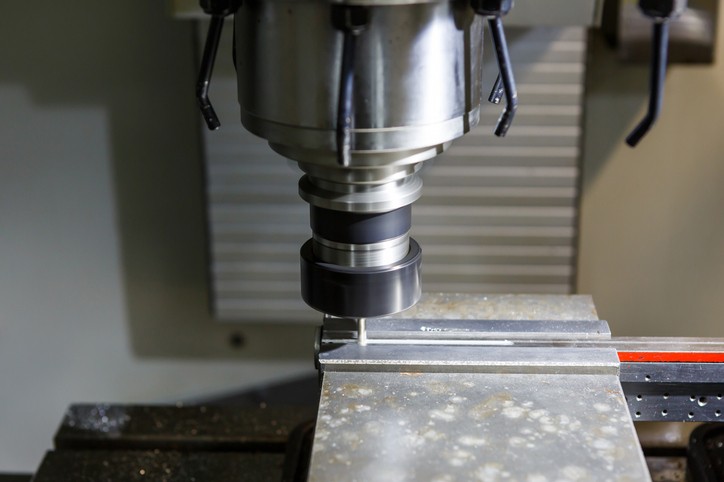
The advantage is straightforward. When one facility handles 5-axis milling, precision turning, AWS-certified welding, and sheet metal fabrication under the same roof, transit time drops to zero. A single team manages the whole schedule, so if machining runs a little long, fabrication can adjust without a new contract or a freight reschedule. That kind of setup lets military contractors keep a predictable timeline regardless of what happens upstream.
Pairing custom machining services with in-house welding keeps a program’s timeline predictable instead of hoping every outside vendor stays on schedule. Rather than splitting a part between separate sheet metal fabricators, platers, and welders, the whole job moves through one coordinated operation from raw material to final inspection.

What Should You Look for in a Defense Manufacturing Partner?
Switching to a consolidated vendor model only works if you vet the new partner carefully. Chasing the cheapest unvetted bidder is a fast way to repeat the same problem.
A dependable manufacturing partner should check these boxes:
- Active ITAR registration so sensitive data and hardware stay protected
- AS9100 and ISO9001 certification, confirming aerospace-grade quality systems
- A documented track record with prime aerospace and defense manufacturers
The most telling sign of resiliency, though, is history. A shop that lists custom metal fabrication, machining, and finishing on its capabilities page still needs years of proof behind it. Decades of experience serving prime military contractors show a vendor has the workforce, equipment, and financial footing to deliver complex assemblies under pressure.
Protect Your Timelines With NAMF
NAMF has supported prime military contractors with single-source precision fabrication for more than 40 years. Housing CNC machining, welding, fabrication, and finishing under one roof lets us cut the compounding delays and compliance risks that come with a fragmented supply chain.
Our shop runs as an extension of your procurement team, backed by AS9100 certification and active ITAR registration. When a program’s critical path is on the line, decades of experience and in-house capability make the difference.
Ready to Simplify Your Supply Chain?
Send your prints for a fast quote, or talk with our supply chain engineers about consolidating your vendor base before your next contract phase begins.