- What Sets Military Contract Manufacturing Apart from Commercial Fabrication?
- How Do ITAR, EAR, and CMMC Shape Defense Manufacturing Requirements?
- Why Does Vertical Integration Reduce Risk in Military Contract Manufacturing?
- Protecting Your Defense Program Starts with the Right Partner
- Frequently Asked Questions
Key Takeaways
- Military contract manufacturing requires documented, repeatable processes and zero-defect conformance at every production stage, not just final inspection.
- Legal compliance with ITAR, DFARS, and CMMC is a baseline requirement for any vendor supporting DoD programs, not an optional upgrade.
- Partnering with a vertically integrated manufacturer reduces supply chain fragmentation and protects documentation continuity across every production phase.
When evaluating vendors for Department of Defense (DoD) programs, procurement managers and lead engineers face a critical threshold. The assumption that any highly capable industrial machine shop can seamlessly transition into defense work is a costly misconception.
Fulfilling government contracts legally and reliably requires far more than tight physical tolerances. It demands a specialized partner capable of navigating strict regulatory requirements, supply chain transparency mandates, and rigorous quality frameworks.
For Tier-1 and Tier-2 supply chain managers, the cost of non-compliance is extreme. Understanding the operational and legal differences between standard commercial fabrication and military contract manufacturing is the first step in securing a resilient defense supply chain.
What Sets Military Contract Manufacturing Apart from Commercial Fabrication?
Military contract manufacturing optimizes for guaranteed reliability, absolute repeatability, and uncompromising security. Commercial manufacturing optimizes for speed, scalability, and cost-efficiency.
That distinction shows up heavily in the back office. In standard industrial fabrication, quality assurance might consist of basic dimensional checks and a standard certificate of conformance. Defense contract manufacturing goes further, requiring comprehensive First Article Inspections (FAI), detailed material certifications, and routing logs that prove every step was executed exactly to the engineered standard.
In defense procurement, “close enough” is not an acceptable standard. It is a liability.
Working with a military contract manufacturing partner means paying for 100% transparent documentation throughout the entire production lifecycle, not just at the end of the line.
How Do ITAR, EAR, and CMMC Shape Defense Manufacturing Requirements?
ITAR (International Traffic in Arms Regulations) and EAR (Export Administration Regulations) create strict legal boundaries around defense manufacturing data and hardware. An ITAR-registered manufacturer is legally bound to restrict access to defense-related technical data. In many cases, a standard commercial shop cannot legally view the CAD files for a DoD project.
Beyond physical security and restricted access for foreign nationals, modern military contract manufacturing demands rigorous network security. The DoD’s transition toward CMMC (Cybersecurity Maturity Model Certification) means vendors must prove their digital infrastructure can protect Controlled Unclassified Information (CUI).
For prime contractors, sourcing from a non-compliant vendor creates liability far beyond scrapped parts. It risks ITAR violations, federal penalties, and immediate contract termination.
What Does DFARS-Compliant Material Sourcing Require?
DFARS (Defense Federal Acquisition Regulation Supplement) mandates that specialty metals used in defense applications be melted or produced in the United States or a qualifying country. This is not optional. It is a strict legal requirement rooted in the Berry Amendment and related national security legislation.
On the shop floor, this means meticulous heat-lot tracking and raw material segregation from the moment metal arrives at the receiving dock. A dedicated defense machining partner isolates DFARS-compliant materials to prevent cross-contamination with commercial-grade metals, ensuring the traceability that standard industrial shops are simply not equipped to provide.
What Do MIL-SPEC and AS9100 Rev D Compliance Actually Demand?
While many high-tier industrial shops hold ISO 9001 certification, military and aerospace programs demand the elevated rigor of AS9100 Rev D. An AS9100-certified machine shop implements stringent risk management, configuration control, and product traceability protocols specifically designed for defense production. When an engineering change occurs mid-production, AS9100 dictates exactly how it is documented, implemented, and verified across the entire production line.
MIL-SPEC performance standards are not equivalent to ASTM or ASME commercial codes. MIL-SPEC finishes involve exact chemistry requirements, controlled application variables, and precise cure controls to withstand extreme combat environments. Validating these processes often requires specialized Non-Destructive Testing (NDT) methods, including penetrant or radiographic inspections calibrated for military aerospace payloads.
Not all sheet metal fabricators are equipped to operate within this compliance framework. Those serving defense programs must apply it consistently, from the first cut through the final inspection record.
Why Does Vertical Integration Reduce Risk in Military Contract Manufacturing?
In standard industrial fabrication, a prime contractor might use one vendor for machining, ship parts to a separate aluminum dip brazing facility, and route them to a third vendor for mil-spec coating. In military contract manufacturing, this fragmentation introduces compounding delays, shipping vulnerabilities, and multiple points of ITAR exposure.
Consolidating machining, NAVSEA welding, brazing, and finishing under one roof removes those handoffs entirely. When sensitive hardware stays within a single ITAR-secure facility, the documentation chain stays intact, and the risk of unauthorized access drops significantly.
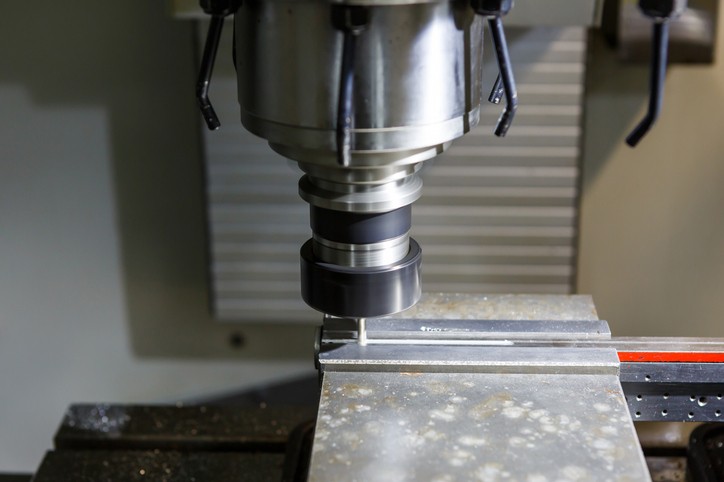
Adding brass welding capabilities for non-ferrous assemblies further reduces the need to outsource specialized joining work. For complex programs requiring tight-tolerance structural components, on-site vertical milling services allow manufacturers to complete these geometries without transferring sensitive hardware to an outside facility.
By keeping these processes within one secure, certified facility, procurement managers eliminate the logistical friction and contamination risks that arise when parts move between multiple sub-tier suppliers.
How Do You Evaluate a Military Contract Manufacturing Partner?
True defense manufacturers integrate testing, specialized bonding, and precise coating into a single compliance system. When vetting a partner for DoD contract manufacturing, procurement professionals must look well beyond the equipment list.
Here is what to verify during qualification:
- DDTC registration: Confirm active ITAR registration and documented controls for CUI handling at the facility.
- QA document retention: Defense contracts often require records stored securely for a decade or more. Ask how long they retain production and inspection records.
- Mil-standard capabilities: Demand proof of how DFARS materials are physically and administratively segregated on the shop floor.
A vendor that cannot immediately produce documentation for each of these requirements is not a qualified military contract manufacturing partner, regardless of shop floor capabilities.
Protecting Your Defense Program Starts with the Right Partner
The hidden costs of fragmented supply chains, including schedule delays, documentation gaps, and quality escapes, consistently exceed the apparent savings of sourcing from multiple lower-tier vendors.
The right military contract manufacturing partner brings full vertical integration, current certifications, and operational agility to manage the production chain from raw material receipt to final delivery. When a component must perform correctly the first time, in the most demanding operational environment, that decision gets made during vendor selection, long before production begins.
NAMF has over 40 years of experience as a single-source defense manufacturer, delivering ITAR-compliant precision fabrication for aerospace, military, and DoD programs from its Fairfield, NJ facility.
Ready to Streamline Your DoD Procurement Cycle?
Submit a drawing to NAMF’s ITAR-secure portal for a precise capabilities review by our engineering team. We will assess your DFARS material requirements and full process flow at no cost.