Key Takeaways
- Military manufacturers win on compliance and documentation, not just machines.
- AS9100 adds about 100 defense and aerospace rules that ISO 9001 leaves out.
- ITAR and CMMC control who can see and store defense data.
- Full material traceability keeps counterfeit parts out of the supply chain.
- Keeping special processes in-house under NADCAP protects your chain of custody.
Military manufacturers and commercial fabricators can own the same machines, yet they are not the same kind of business. The real difference is not thicker steel or a faster laser. It is the paperwork, the security, and the proof behind every part.
What Really Sets Military Manufacturers Apart?
Military manufacturers are built around documented evidence, not just physical output. In defense work, a part barely exists until you can prove where the metal came from and how it was made. Commercial shops are built for speed, volume, and low cost instead.
Think of defense fabrication as half metalwork and half records. Precision cutting and forming are the easy part. The hard part is tracking, securing, and documenting every step.
Why Isn’t Military Work Just Commercial Fabrication With Tougher Metal?
Treating a defense job like a standard order is where risk creeps in. One undocumented material swap or a failed government audit can stall a whole program. A single bad part in the field can cost lives.
The threat is not hypothetical. The May 21, 2012 Senate Armed Services Committee report, “Inquiry Into Counterfeit Electronic Parts in the Department of Defense Supply Chain,” found about 1,800 cases of suspect counterfeit electronic parts, involving well over one million individual parts, with roughly 70 percent traced to China. As Chairman Carl Levin put it, “Our report outlines how this flood of counterfeit parts, overwhelmingly from China, threatens national security, the safety of our troops, and American jobs.”
Strong capabilities still matter. NAMF runs aluminum laser cutting on a TruLaser 2030 fiber system that handles 5052 and 6061 alloys up to 1.5 inches thick. But equipment alone does not qualify a shop for defense work.

How Is AS9100 Different From ISO 9001?
Most solid commercial shops hold ISO 9001. That standard sets a decent baseline, but it stops short of what defense and aerospace demand. AS9100 Rev D includes the full text of ISO 9001:2015 and adds roughly 100 aviation, space, and defense requirements on top, published by the International Aerospace Quality Group in shaded text throughout the document.
Those extras cover risk management, configuration control, foreign object debris prevention, and product safety. They also demand a First Article Inspection, a full dimension-by-dimension check of the first part before production runs. A commercial approval might take a few hours. A defense First Article Inspection can take days.
For custom aluminum fabrication on a defense program, NAMF uses its AS9100D certification as a daily operating system, not a wall plaque. Every process is mapped, controlled, and audited so the thousandth part matches the first.
How Do ITAR and CMMC Change the Way Data Is Handled?
Commercial shops often email CAD files or drop them in a shared link to speed up quoting. In defense work, that habit can break the law. Military hardware falls under the International Traffic in Arms Regulations, known as ITAR.
ITAR requires strict access controls, so only authorized U.S. persons can view or handle defense drawings and parts. NAMF is ITAR-registered for this reason.
Data security has tightened further. The Department of Defense is rolling out the Cybersecurity Maturity Model Certification, or CMMC, to protect Controlled Unclassified Information like part geometry and specs. The CMMC DFARS final rule was published on September 10, 2025, and took effect on November 10, 2025, eventually reaching nearly 338,000 entities, about 68 percent of them small businesses. In July 2026, the DoD paused the Phase II third-party assessment requirements pending review, but the underlying duty to protect that data has not gone away. Many commercial shops simply lack the network controls and floor separation to handle this information legally.
Why Does Material Traceability Matter So Much?
In defense, documented reality beats physical reality. If you cannot prove where a component came from, the government treats it as if it does not exist. Commercial buyers often grab metal from whichever broker is cheapest that day.
Military manufacturers work under full lifecycle traceability. That means mill certificates and heat-lot tracking from the receiving dock to final delivery. DFARS clause 252.225-7009 also states that “any specialty metals incorporated in items delivered under this contract shall be melted or produced in the United States, its outlying areas, or a qualifying country,” a rule rooted in the 1973 Berry Amendment.
This paper trail is the main defense against counterfeit parts. By buying only from approved, vetted sources and checking chemistry, a shop keeps fake or substandard alloys out of the supply chain.
What Is the NADCAP Advantage in Secondary Processing?
Fabrication is rarely the last step. Parts still need heat treating, coating, and specialized joining to survive harsh conditions. Commercial shops usually farm this out, and every handoff adds delay, cost, and a break in the chain of custody.
Military manufacturers keep these steps in-house under NADCAP accreditation. NADCAP is the aerospace and defense standard for special processes, run by the Performance Review Institute. It proves a shop performs each process to prime-contractor requirements.
NAMF brings defense welding, aluminum dip brazing, and chemical film coating under one AS9100-controlled roof. Its welders are certified to AWS D17.1 and AWS D1.2, and its chemical conversion coating meets Mil-DTL-5541. Keeping this work in one place cuts the risk that comes from juggling multiple outside vendors.
How Should You Evaluate Your Next Defense Fabrication Partner?
Look past the equipment list. The real cost of a mismatch shows up when a shop fails an audit, mishandles protected data, or loses traceability mid-run. Ask any candidate to show:
- Active ITAR registration and clear controls for handling protected data.
- Current AS9100 and NADCAP certifications, not expired ones.
- Proof of how DFARS materials are tracked and kept separate on the floor.
A single-source partner also lowers risk. When custom metal fabrication, machining, and finishing happen under one certified roof, your documentation stays intact, and sensitive parts never travel between strangers.
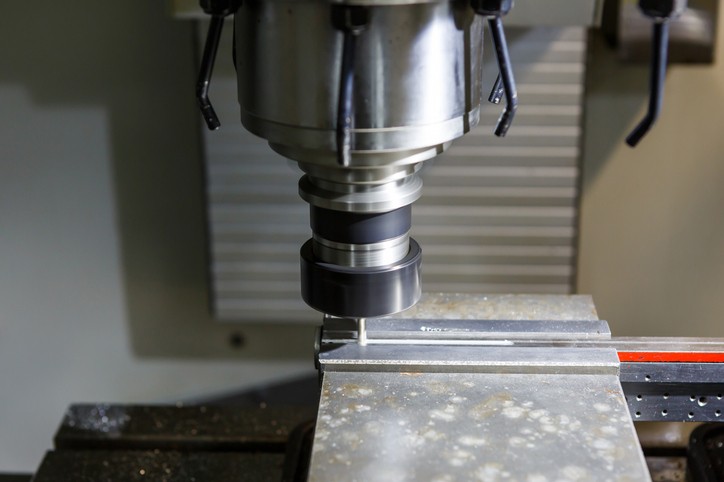
NAMF has done exactly this since 1979, serving programs for clients like General Dynamics, Northrop Grumman, Lockheed Martin, and Raytheon. Its CNC manufacturing runs on more than two dozen milling machines, including 5-axis centers for complex parts.
That mix of certifications and in-house capability is what separates a true defense supplier from a general shop. When you choose metal fabrication services for a mission-critical program, treat compliance as the deciding factor, not an afterthought.
Get Defense Parts That Pass Inspection the First Time
Send NAMF your drawing, and our engineering team will review your specs, certifications, and material needs at no cost. You work with one contact from raw metal to a finished, ready-to-install part.