Key Takeaways
- Defense applications require tolerances tighter than ±0.0001 inches (2.54 µm), a standard that manual machining cannot reliably achieve across large production runs.
- Custom CNC machining eliminates setup-error buildup by machining complex geometries in a single operation, especially with 5-axis milling.
- CNC programming accounts for dimensional changes during post-machining surface treatments, ensuring compliance with NAMF and MIL-SPEC finishing standards.
- The code-driven nature of CNC machining provides the digital traceability required for ITAR, AS9100D, and First Article Inspection compliance.
- Machining superalloys like Titanium Grade 5 and Inconel requires the feed-rate consistency of CNC equipment to prevent work-hardening and tool failure.
In defense procurement and aerospace engineering, the standard cost-benefit analysis used in commercial manufacturing simply does not apply. When a component goes into a ballistic missile system, a tactical aircraft, or frontline ordnance, dimensional failure is not just a scrapped part. It is a catastrophic system failure.
To achieve strict MIL-SPEC tolerances, part repeatability, and end-to-end traceability, defense contractors must move from manual operations to ITAR-compliant custom CNC machining. This is not just a production speed upgrade. It is a fundamental requirement for securing the supply chain and guaranteeing that every mission-critical component performs reliably under extreme environmental stress.
Why Defense Precision Operates on a Zero-Failure Margin
Military hardware operates in environments with severe vibration, extreme thermal fluctuations, and high-impact ballistics. Under these conditions, the definition of precision shifts dramatically.
Commercial manufacturing might tolerate dimensional variances of ±0.005 inches (0.13 mm). Defense applications frequently demand exactness down to ±0.0001 inches (2.54 µm). At this microscopic scale, acceptable commercial variance becomes a critical defense liability.
A microscopic deviation in a turbine blade or guidance housing can induce harmonic resonance, leading to rapid material fatigue and structural failure. Achieving a zero-failure margin requires removing human physical inconsistency from the cutting equation entirely. Custom CNC machining provides this level of control, using advanced software and rigid machine architecture to hit sub-micron tolerances repeatedly on every single component.
Where Manual Machining Reaches Its Limit
Manual machining still has a place in industrial fabrication. It works for temporary tooling, basic jigs, or low-complexity mockups where exact tolerances are secondary to rapid, one-off execution. But when applied to modern warfare components, the manual process hits a hard ceiling.
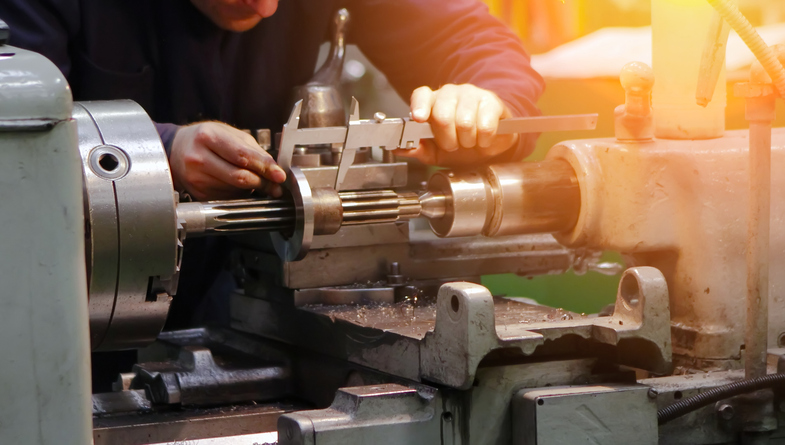
The main vulnerability of manual machining is operator fatigue and the need for multiple physical setups. Machining complex defense geometries by hand requires an operator to repeatedly unchuck, reposition, and re-indicate the workpiece. Each move introduces a microscopic margin of error. Across a production run of 1,000 or more units, those setup errors accumulate into dangerous variance runout.
Manual equipment also struggles to hold consistent feed rates when cutting high-hardness alloys required for military use. The friction dulls traditional tooling fast, leading to torn surface finishes, out-of-spec dimensions, and high scrap rates that disrupt tight procurement timelines.

How Custom CNC Machining Solves These Challenges
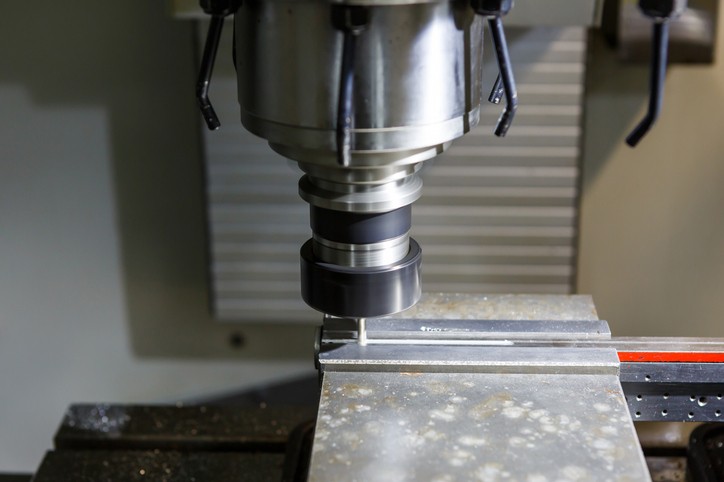
Modern defense systems feature intricate internal geometries that are physically impossible to mill or turn by hand. Precision fabrication at this level demands 4-axis and 5-axis concurrent milling, which allows manufacturers to sculpt highly complex features without removing the part from the machine’s chuck. Keeping the workpiece locked in a single setup eliminates the buildup of repositioning errors and ensures perfect concentricity on every part.
This capability is especially critical when working with demanding defense materials. Alloys like Inconel, Titanium Grade 5 (Ti-6Al-4V), 7075-T6 aluminum, and armored stainless steel are notoriously difficult to machine. They require optimized, rapid-feed consistency and precise toolpath engagement to prevent work hardening and tool breakage. Custom CNC machining systems monitor spindle loads in real time, adjusting feed rates dynamically to cut through superalloys with repeatable precision. The result: the thousandth part is dimensionally identical to the first.
For aluminum components specifically, an aluminum milling service equipped with modern CNC centers can hold tight tolerances on aerospace-grade alloys while meeting the production throughput demands of defense programs.
Securing Pre-Finish Tolerance and Finishing Compliance
Precision bare-metal machining is only half the job. Defense components must go through rigorous surface treatments, including chromate conversion, hardcoat anodizing, or specialized plating, to survive corrosive environments. These treatments add measurable thickness to the part.
Organizations following National Association for Surface Finishing (NASF) guidelines and stringent MIL-SPEC standards understand that precise part geometry is directly tied to finishing compliance. If a manual machining process leaves a part even slightly oversized, the subsequent protective coating will push the component completely out of tolerance.
Custom CNC machining addresses this risk directly. Engineers can program exact dimensional offsets into the G-code, predicting and mapping the dimensional growth that will occur during the finishing process. This ensures that once the uniform film thickness is applied, the final component meets final assembly specifications without secondary rework.
Complete defense assemblies also require specialized joining processes alongside precision machining. Defense welding, including certified TIG and electron beam welding, must meet strict AWS D17.1 standards that go well beyond commercial welding codes. Each welder on defense programs must hold process-specific certifications before working on any assembly. For components requiring tight-fit, metallurgically bonded joints without excessive heat input, dip brazing is a reliable solution. It is particularly effective for aluminum structures that require consistent joint strength across complex geometries. Engineers specifying full assemblies should also understand the full range of types of brazing available, from torch and furnace to vacuum processes, to select the right method for each application. When components also require complex cut profiles or precise edge geometry, precision laser cutting delivers tight dimensional control that integrates cleanly into CNC machined assemblies without introducing heat distortion in the surrounding material.
Traceability, Compliance, and the Digital Thread
In the modern defense supply chain, data is just as critical as hardware. Regulatory frameworks such as ITAR, AS9100D, and the Cybersecurity Maturity Model Certification (CMMC) demand rigid oversight, secure data governance, and complete traceability. Manual machining lacks the automated data capture required to satisfy these audits.
Custom CNC machining generates a continuous digital thread. The reproducible G-code that drives the machine integrates seamlessly into ISO 9001:2015 and AS9100D quality workflows. This code feeds natively into Coordinate Measuring Machine (CMM) validations, providing the exact, unalterable data required for First Article Inspections (FAI).
By using highly documented, code-driven processes, defense contractors can prove that every cut, drill, and pass was executed exactly to the approved specification. This eliminates compliance blind spots and secures the supply chain against unauthorized deviations.

What to Look for in a Defense CNC Machining Partner
Transitioning to high-end manufacturing requires a vendor who understands the gravity of military applications. Defense purchasers should look beyond hourly rates and evaluate a partner’s systemic capability to mitigate risk.
When vetting a custom CNC machining partner, prioritize these three criteria:
- Metrology investment: Ensure the facility uses advanced CMM equipment and optical comparators capable of validating sub-micron tolerances.
- Regulatory certifications: Verify active compliance with ITAR, AS9100D, and CMMC frameworks to guarantee secure handling of restricted defense data.
- Engineering support: Seek partners who offer manufacturing engineering support and can optimize designs for both machining and post-process NAMF-compliant finishing.
The Standard Is Non-Negotiable
Protecting critical defense applications starts with unparalleled tolerances and secure data practices. By demanding custom CNC machining over legacy manual processes, procurement officers can eliminate human error, ensure regulatory compliance, and guarantee the reliability of mission-critical hardware.
In defense manufacturing, “close enough” is not a standard. It is a risk. Minimize scrap and guarantee repeat dimensional accuracy by working with a machining partner who treats every part as mission-critical.
Take the Next Step Toward Mission-Ready Components
NAMF delivers custom CNC machining solutions built to MIL-SPEC standards, with full ITAR compliance and end-to-end traceability from the first cut to final inspection.