Key Takeaways
- Rogue rust comes from stray iron particles, not a flaw in the metal, and dedicated tooling stops it.
- Stainless steel expands about 50% more than mild steel when heated, so warping control depends on managing heat, not luck.
- Sensitization quietly strips chromium from the weld area, and low-carbon grades plus fast cooling are the fix.
- Skipped back-purging causes oxidation and sugaring, which can cause sanitary inspections to fail on food and pharmaceutical parts.
- Pickling and passivation after welding restore the protective layer, so finishing matters as much as the weld itself.
Stainless steel is prized for its strength, its clean look, and its natural resistance to rust. None of that holds up if the fabrication of stainless steel is handled carelessly. Mild steel tolerates a wide range of shop conditions. Stainless steel does not. It reacts fast to contamination, uneven heat, and skipped finishing steps.
For engineers, supply chain managers, and OEMs, downstream failures almost always trace back to the shop floor. Rust on a “stainless” part, a warped assembly, or a weld that fails months later is rarely a bad batch of material. It is a process defect. And it is preventable.
This guide covers the five defects that show up most in the fabrication of stainless steel. They are rogue rust, warping, sensitization, weld oxidation, and skipped finishing. Each section explains why the defect happens and how a skilled fabricator stops it. That holds true whether the part is bound for a food-grade line or a custom metal fabrication program supporting aerospace hardware.
Why Cross-Contamination Causes Rust on Stainless Steel
One of the most frustrating things an OEM can see is rust on a part chosen specifically because it should not rust. This is called rogue rust. It is rarely a failure of the alloy. It is almost always the result of iron embedding and carbon cross-contamination during fabrication.
Here is how it happens, a fabricator uses a grinding wheel, wire brush, or forming die on carbon steel. Then that same tool touches stainless steel. Microscopic iron particles embed in the stainless surface. Once that surface meets moisture or oxygen in the field, the trapped iron oxidizes. That creates localized corrosion right where the stainless should have held strong.
The risk is not limited to shared tools. In a mixed-metal shop without strict spatial separation, airborne iron dust from grinding stations can settle on a perfectly welded stainless part. Reliable fabrication partners avoid this problem. They run dedicated stainless-only areas or tightly controlled clean rooms. They use color-coded hand tools and manage airflow so shop dust never touches a high-value assembly. That same discipline should carry over to every other job the shop runs. It should not matter whether the material on the table is stainless, aluminum, or something else entirely.
Why Stainless Steel Warps During Fabrication
Holding tight dimensional tolerances is hard enough on its own. The thermal behavior of austenitic stainless steel makes it harder. The fabrication of stainless steel demands real command of heat. That is because 300-series alloys expand roughly 50% more than mild steel when heated, according to ASM International materials data. Stainless also has much lower thermal conductivity, so heat does not spread out. It stays concentrated right at the weld.
That trapped heat causes aggressive, uneven expansion. Hard contraction follows as the joint cools. The result is a part pulled out of tolerance, sometimes badly enough that later CNC machining cannot fully correct it. Distortion caught after the fact costs time and material that proper heat management would have saved.
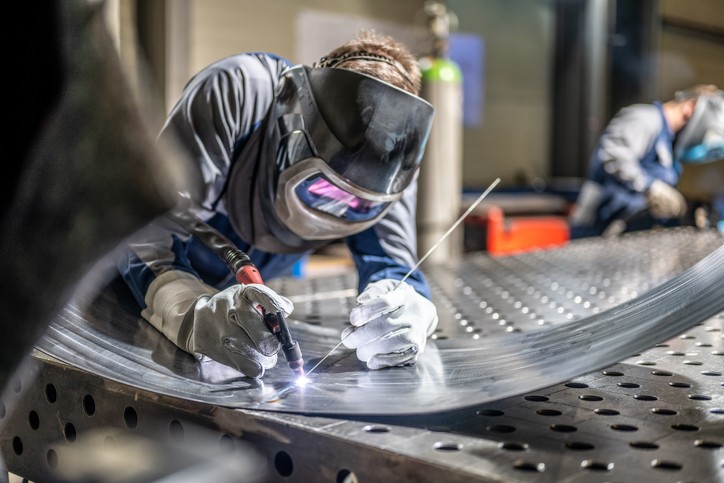
Preventing this takes planning before the arc is ever struck. Skilled fabricators use staggered welding sequences to spread thermal stress evenly. They also rely on heavy fixture clamps, copper chill bars, and tight amperage control to pull heat away from the joint fast. Shops that run CNC rapid prototyping on early design iterations can catch warp-prone geometries before a full production run. That saves both the client’s timeline and the finished tolerances.
Sensitization and Carbide Precipitation: A Hidden Corrosion Risk
Beyond visible distortion, poor heat control during the fabrication of stainless steel can quietly change the metal’s chemistry. When austenitic stainless steel sits between roughly 800°F and 1500°F for too long, carbon inside the alloy bonds with chromium. This reaction is called carbide precipitation, or sensitization. It strips chromium away from the area right next to the weld.
Chromium forms the invisible oxide layer that gives stainless steel its corrosion resistance. Once that chromium gets tied up in carbides, the heat-affected zone becomes an easy target for intergranular corrosion. A sensitized weld can look completely sound to the eye and still fail fast in a harsh chemical or marine environment. That hidden risk is exactly what worries military manufacturers sourcing parts for demanding field conditions.
Preventing sensitization takes two steps. First, engineers often specify low-carbon grades, such as 304L or 316L. These limit how much carbon is available to bond with chromium. Second, fabricators use rapid cooling and tight interpass temperature control. That keeps the metal moving through the danger zone quickly instead of lingering in it.
Heat Tint and Sugaring: Oxidation Defects at the Weld
A weld’s appearance usually tells the truth about how carefully the fabrication of stainless steel was handled. During welding, molten stainless steel needs full protection from atmospheric oxygen, a standard the American Welding Society has documented for decades. Most fabricators shield the top of the weld well. The underside of the joint gets neglected more often than it should.
When the back of a stainless weld hits oxygen at high heat, it oxidizes badly. In severe cases, this shows up as “sugaring,” a porous, granular surface defect. For food-grade, dairy, or pharmaceutical work, sugaring is a dealbreaker. The porous texture gives bacteria a place to grow, and it fails sanitary inspection outright.
Even a mild rainbow-colored heat tint is a warning sign. It means the protective chromium-oxide layer has been compromised. Skilled fabricators prevent this by back-purging the joint with an inert gas, usually argon. That keeps the entire heat-affected zone oxygen-free until it cools well below the danger range. Shops that also run aluminum dip brazing services tend to apply this same atmosphere control everywhere. It is not limited to stainless welding alone.
Post-Fabrication Finishing: Restoring the Protective Layer
The fabrication of stainless steel is not finished when the welding arc goes out. Cutting, bending, and welding disturb the material’s passive layer, even with perfect heat control and back-purging. What separates a standard job shop from a premium manufacturing partner is what happens next: proper finishing.
Restoring full corrosion resistance takes chemical treatment. Pickling uses a blend of nitric and hydrofluoric acids to strip away heat tint, scale, and the chromium-depleted layer underneath. Passivation follows. It often meets standards like ASTM A967, using nitric or citric acid to remove leftover free iron. This speeds up the regrowth of a thick, even chromium-oxide layer.
Organizations like the National Association for Surface Finishers (NASF) have pushed the industry toward strict post-process cleaning and finishing protocols for years. Parts that meet these standards perform as designed, whether they end up in a commercial kitchen or on a corrosive marine dock. A well-rounded shop rounds out its metal fabrication services with the same rigor for other alloys, not just stainless.
Aluminum parts that share an assembly with stainless components often need their own protection, too. Alodine coating gives aluminum the corrosion resistance and paint adhesion that passivation provides for stainless steel.
How to Vet a Partner for the Fabrication of Stainless Steel
Choosing a vendor capable of flawless stainless steel work means looking past their equipment list. A strong partner should speak in detail about contamination prevention, thermal expansion management, and the finishing standards they hold themselves to.
When auditing a shop, ask about floor segregation between metals. Ask how they handle back-purging on complex geometries. Ask whether passivation happens in-house or through a trusted partner. It also helps to ask about the breadth of their manufacturing solutions. A shop that only handles one process forces you to juggle multiple vendors for a single assembly. A team equipped for CNC machining, welding, and finishing under one roof catches problems earlier and hands off cleaner parts. That matters most on programs with tight documentation requirements, like military contract manufacturing work.
A fabricator who understands the full lifecycle of a part protects your brand from costly downstream failures. That means knowing the process from raw material handling through NAMF-aligned finishing. That knowledge is what keeps rogue rust and weld degradation out of your finished parts.
Are your current designs dealing with unexplained corrosion or dimensional drift? It may be time to take a closer look at your supply chain. A fabrication partner who treats finishing as seriously as welding makes all the difference. A part that looks right on day one should still perform five years later.
Get a Zero-Defect Stainless Steel Fabrication Quote
Stop guessing whether your supplier’s process controls match their promises. NAMF combines dedicated stainless facilities, rigorous heat management, and NAMF-aligned finishing. The result: parts that hold up in the field, not just on the inspection table.