- Start with Design for Manufacturability in Prototype Machining Services
- Leverage First Article Inspection
- Optimize Batch Sizing for Cost Efficiency
- Integrate CNC Machining with Complementary Processes
- Test Early, Test Often, Test Realistically
- Plan Your Production Transition
- Conclusion
- Frequently Asked Questions
Key Takeaways
- Design for Manufacturability (DFM) prevents costly errors by identifying production issues during the prototype phase, ensuring your design can be efficiently manufactured at scale.
- First Article Inspection (FAI) provides documented proof that prototypes meet specifications, establishing a quality baseline for production while satisfying regulatory requirements.
- Strategic batch sizing and single-source manufacturing reduce costs and timelines by eliminating vendor handoffs and spreading setup expenses across multiple units.
Rapid prototype machining transforms how defense and aerospace manufacturers develop components. The difference between a prototype that validates your design and one that creates costly delays comes down to how you approach the process.
We’ve spent over 40 years refining prototype machining for mission-critical applications. Through our work with leading dip brazing companies and defense contractors, we’ve identified the patterns that separate successful projects from expensive failures.
Here’s what works.
Start with Design for Manufacturability in Prototype Machining Services
Your prototype needs to reflect production realities. The best design on paper fails if you can’t manufacture it efficiently at scale.
DFM (Design for Manufacturability) catches problems before they become expensive. When you collaborate with your fabrication partner during the design phase, you identify potential issues with tolerances, material selection, and assembly complexity.
We review designs with engineering teams before production begins. This collaborative approach reveals opportunities to simplify geometries, reduce setup operations, and optimize fixture requirements.
The result? Prototypes that accurately represent production parts.
Consider tooling access, material thickness variations, and stress concentrations during bending or forming operations. These factors affect both prototype accuracy and eventual production feasibility.
Material Selection Matters More Than You Think
Aluminum alloys dominate aerospace applications for good reason. The strength-to-weight ratio, corrosion resistance, and machinability make aluminum ideal for military enclosures and precision components.
But not all aluminum alloys behave identically during machining or dip brazing.
6061 aluminum offers excellent machinability and weldability. It’s our go-to for prototypes requiring complex geometries and tight tolerances. Understanding the differences between treatments like alodine vs anodize helps you select the right surface finish for corrosion protection. For applications demanding higher strength, 7075 aluminum provides superior mechanical properties, though it’s more challenging to machine.
Your prototype should use the same material grade planned for production. Material substitutions during prototyping create false validation and unexpected problems during scale-up.
Leverage First Article Inspection
First Article Inspection (FAI) verifies that your prototype meets all engineering and design specifications. This systematic process documents dimensional accuracy, material properties, and surface finish characteristics.
FAI provides objective evidence that your prototype matches design intent. For defense contractors working under ITAR compliance requirements, this documentation becomes essential for program approval and regulatory adherence.
The inspection process includes:
- Dimensional verification using CMM (Coordinate Measuring Machine) technology
- Material certification and traceability documentation
- Surface finish measurement and analysis
- Functional testing where applicable
- Photographic documentation of critical features
We maintain detailed FAI records for every prototype. When you move to production, these records serve as your baseline for quality control and process validation.
The “Fail-Fast” Approach Saves Money
Catching design issues during prototyping costs significantly less than discovering them during production. Strategic prototyping delivers substantial reductions in total project costs by eliminating rework, material waste, and project delays.
You want to stress-test your design before committing to production tooling.
Run your prototype through realistic operational scenarios. Apply the thermal cycling, vibration, and environmental conditions the final component will experience. Document failure modes and refine the design accordingly.
This iterative approach feels slower initially. It’s not. Fixing problems during prototyping takes days. Fixing them during production takes months and costs exponentially more.
Optimize Batch Sizing for Cost Efficiency
Programming, setup, and CAD/CAM preparation costs remain largely fixed regardless of quantity.
When you produce a single prototype, you absorb the entire setup cost. Increasing quantity spreads these expenses across multiple units, significantly reducing per-part costs.
Smart batching means producing multiple prototypes or validation units in a single run.
You gain several advantages:
- Lower per-unit costs through shared setup expenses
- Multiple test articles for different validation scenarios
- Spare components for destructive testing
- Backup units for stakeholder demonstrations
We help clients determine optimal batch sizes based on their testing requirements and budget constraints. Sometimes producing 10 prototypes costs only marginally more than producing three, but provides significantly more validation capability.
Timeline Compression Through Advanced Prototype Machining Services
Speed matters in defense and aerospace development. Your competitors are moving fast. Program timelines are compressed. Delays create cascading problems across multiple stakeholders.
Rapid prototyping reduces development timelines significantly while maintaining production-quality standards.
This acceleration comes from integrated capabilities under one roof. When you work with a single-source provider offering CNC machining, metal fabrication, and dip brazing, you eliminate handoffs between multiple vendors.
No waiting for parts to ship between facilities. No coordination headaches across different quality systems. No finger-pointing when problems arise.
We control each step in the manufacturing process. Your prototype moves directly from machining to finishing to assembly without leaving our facilities in Fairfield, NJ, or Ronkonkoma, NY.
Integrate CNC Machining with Complementary Processes
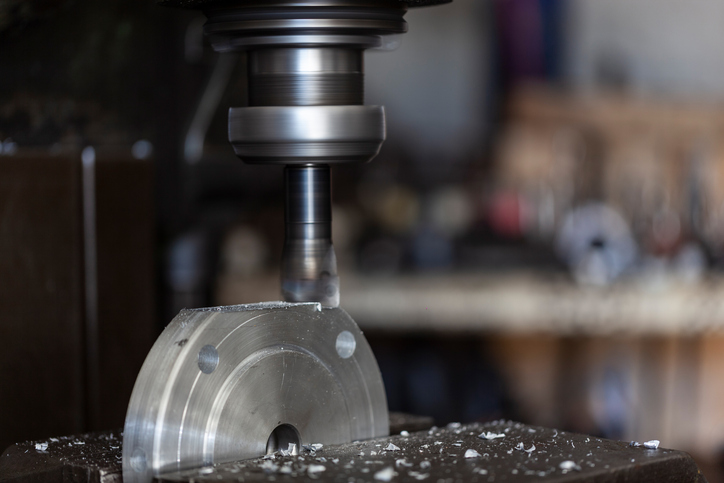
Precision machining creates your core geometry. But most aerospace prototypes require additional processes to meet final specifications.
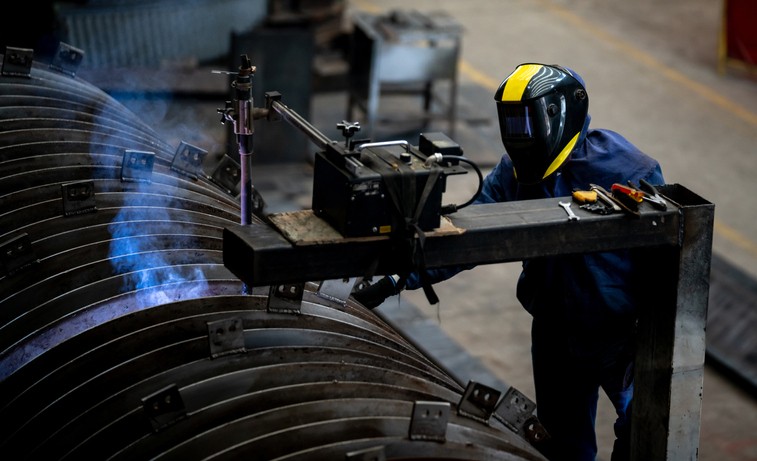
Dip brazing joins aluminum assemblies through controlled immersion in molten salt. This process creates hermetically sealed enclosures with superior structural integrity and thermal conductivity. Understanding welding vs fabrication helps you choose the right joining method for your specific application requirements.
For prototypes requiring complex internal structures or multi-component assemblies, dip brazing offers advantages over other joining methods:
- Uniform joint strength across all brazed interfaces
- No heat-affected zones that compromise material properties
- Ability to join multiple components simultaneously
- Clean, professional appearance without visible fasteners
Chemical conversion coating and painting provide corrosion protection and meet MIL-SPEC requirements. Your prototype should undergo the same finishing processes planned for production units.
This integrated approach ensures your prototype accurately represents the final product’s performance characteristics, not just its geometry.
Documentation and Traceability for Custom Sheet Metal Fabrication
Defense and aerospace applications demand rigorous documentation. Your prototype documentation establishes the foundation for production quality systems. Advanced manufacturing methods like 5 axis milling enable complex geometries that traditional three-axis machines cannot achieve, expanding design possibilities for your prototypes.
We maintain complete traceability for every prototype:
- Material certifications with heat lot traceability
- Process travelers documenting each manufacturing step
- Inspection reports with dimensional data
- Non-conformance reports and corrective actions
- Revision control for engineering changes
This documentation satisfies AS9100 quality management requirements and supports NADCAP accreditation standards. When you transition to production, these records provide your quality baseline.
Test Early, Test Often, Test Realistically
Your prototype exists to validate assumptions. The testing strategy determines how much you learn.
Functional testing under realistic conditions reveals problems that dimensional inspection misses. Temperature cycling, vibration testing, and environmental exposure simulate operational stresses.
For ruggedized enclosures, test electromagnetic interference (EMI) shielding effectiveness. For structural components, validate load-bearing capacity under expected stress conditions. For thermal management applications, measure heat dissipation performance.
Document everything. Temperature profiles, vibration frequencies, failure modes, and performance degradation over time all inform design refinements.
We support clients in developing test protocols that align with their validation requirements. Sometimes this means producing prototypes with built-in test features or instrumentation ports that won’t appear in production units.
Stakeholder Communication Through Physical Prototypes
CAD models and engineering drawings communicate design intent to technical audiences. Physical prototypes communicate with everyone else.
Program managers, procurement teams, and end users understand tangible objects. A prototype in hand generates feedback that drawings never capture.
You’ll hear concerns about handling characteristics, connector accessibility, maintenance procedures, and integration challenges. This feedback shapes design refinements that improve the final product.
Prototypes also accelerate approval processes. Decision-makers evaluate physical prototypes faster than reviewing technical documentation. The ability to hold, examine, and interact with a component builds confidence in the design approach.
Plan Your Production Transition
Your prototype validates the design. The production transition validates your manufacturing process.
The gap between prototype and production creates risk. Different equipment, different operators, different facilities all introduce variables that affect final product quality.
Minimize this gap by prototyping with production-intent processes. Use the same CNC machines, cutting tools, and fixturing approaches planned for production. Apply identical quality control procedures and inspection criteria.
When prototype and production use consistent methods, you reduce transition risk and accelerate production ramp-up.
We prototype on the same equipment used for production runs. This consistency means your prototype accurately predicts production capabilities, cycle times, and quality outcomes.
Continuous Improvement Through Prototype Learning
Every prototype teaches you something. The question is whether you capture and apply those lessons.
Document what worked and what didn’t. Record cycle times, tool wear patterns, and process challenges. Note operator feedback about fixturing, access, and handling.
This information becomes invaluable during production planning. You’ll make better decisions about tooling investments, process sequencing, and quality control strategies.
Strategic prototyping delivers competitive advantages through faster development cycles and reduced program risk.
Conclusion
We’ve refined our prototyping methodology through decades of defense and aerospace work. Our dual facilities in Fairfield, NJ, and Ronkonkoma, NY, provide redundancy and scalability for your programs.
Our NADCAP, NAVSEA, and ISO accreditations demonstrate our commitment to the quality standards your programs require. We understand ITAR compliance, MIL-SPEC requirements, and the documentation rigor defense contractors demand.
More importantly, we understand the pressure you face. Compressed timelines, technical complexity, and program visibility create stress. Our role is making the prototyping phase smooth, predictable, and successful.
You get a single point of contact for design collaboration, manufacturing execution, and quality documentation. No coordination headaches across multiple vendors. No gaps in communication or responsibility.
Your mission-critical components deserve a manufacturing partner who understands what’s at stake.
Start Your Project with NAMF
Our team is ready to transform your design concepts into precision prototypes that validate your program requirements. Contact us today to discuss how our integrated prototype machining services can accelerate your development timeline.