- What Precision Welding Actually Means in Defense and Aerospace
- Welding Processes NAMF Uses and Why They Matter
- Materials We Weld: From Aluminum to Inconel
- Hermetic Sealing: Protecting Mission-Critical Electronics
- Certifications That Back Every Weld We Make
- How Precision Welding Fits Into NAMF's Turnkey Process
- The Real Cost of Choosing the Wrong Welding Partner
- Precision Built From 1979 to Now
- Frequently Asked Questions
Key Takeaways
- NAMF’s precision welding services are specifically engineered for defense and aerospace applications, where even a microscopic weld defect can compromise an entire mission-critical assembly.
- NAMF works with exotic materials including Inconel, Titanium, Waspaloy, and specialized aluminum alloys that most general fabricators cannot reliably weld.
- NAVSEA and NADCAP certifications mean NAMF’s welding processes are independently verified to meet the strictest military and aerospace quality standards in the industry.
- Laser and electron beam (EB) welding minimize heat-affected zones, preventing the warping and cracking common with conventional TIG welding on thin or exotic substrates.
- As a single-source custom metal fabrication provider, NAMF handles everything in-house, from welding and machining to finishing, so you work with one contact from quote to delivery.
When a component fails in the field, the conversation rarely starts with “How much did it cost?” It starts with “Why did it fail?” In defense and aerospace manufacturing, that question can carry enormous consequences.
Precision welding services are the backbone of assemblies that must perform under extreme pressure, temperature swings, vibration, and electromagnetic interference. The weld that holds a ruggedized enclosure together, or seals a flight-critical electronics housing, is not a commodity process. It is an engineered outcome that requires certified processes, qualified welders, and materials expertise most manufacturers simply do not have.
At New Age Metal Fabricating (NAMF), precision welding has been at the center of our work since 1979. We weld components that go into programs for Lockheed Martin, Northrop Grumman, Airbus, and other major defense and aerospace organizations. This article walks you through exactly how we do it, what makes it different, and why it matters for your next project.
What Precision Welding Actually Means in Defense and Aerospace
Not all welding is precision welding. General-purpose welding prioritizes speed and structural integrity for relatively forgiving applications. Precision welding, by contrast, controls every variable in the process: heat input, travel speed, filler material, shielding gas, fixturing, and post-weld inspection.
In defense and aerospace, the requirements go further still. Your supplier must be able to document and repeat the process exactly. That means written weld procedures, qualified welders, in-process inspection, and traceability at every step.
Why Standard Welding Falls Short for Defense Applications
A weld that looks clean to the naked eye can still carry internal porosity, micro-cracks, or incomplete fusion that only shows up under dye penetrant testing or radiography. For structural components or hermetically sealed enclosures, these hidden flaws are unacceptable.
This is also why choosing a capable custom metal fabrication partner matters from the very beginning of your project. When your fabricator handles welding, machining, and finishing under one roof, there are no handoff points where quality standards can slip or accountability gaps can form.
Welding Processes NAMF Uses and Why They Matter
NAMF uses a combination of welding technologies selected based on material type, joint geometry, application environment, and the tolerances your design requires. The two primary methods for our most demanding applications are laser welding and electron beam (EB) welding.
Laser Welding
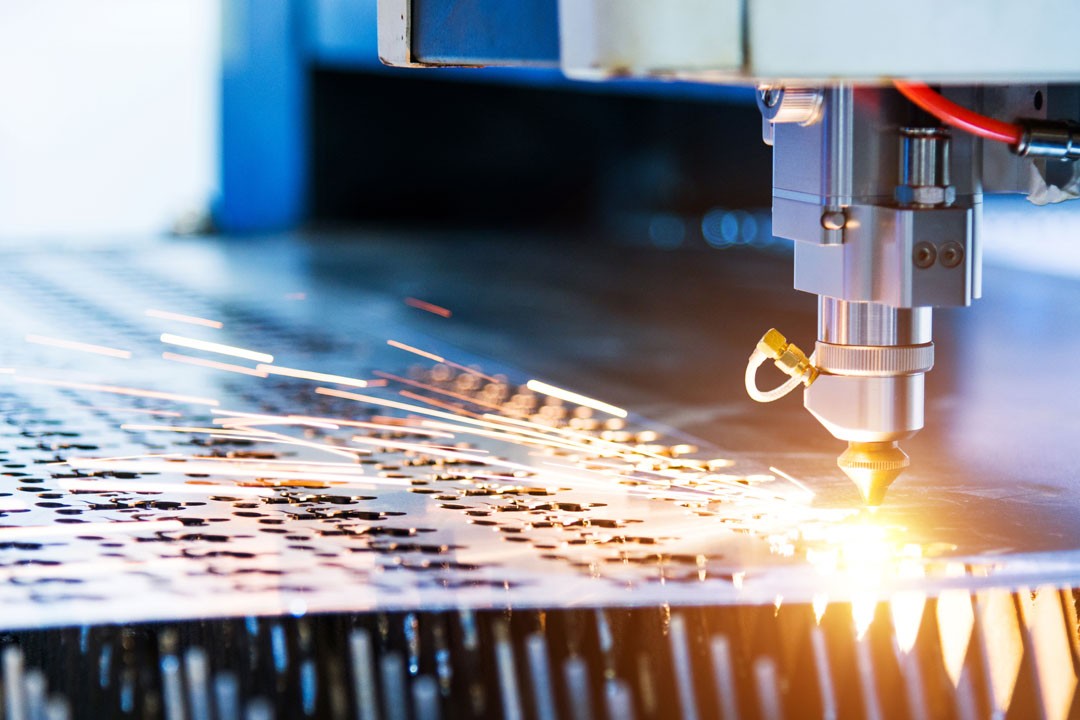
Laser welding uses a focused, high-intensity beam of light to generate the heat needed to fuse metals. One of its most significant advantages for defense and aerospace work is the small heat-affected zone (HAZ) it creates.
A smaller HAZ means less thermal stress on the surrounding material. This is critical when you are working with thin-walled assemblies, hermetically sealed enclosures, or components made from alloys that are prone to distortion when exposed to sustained heat. Many precision assemblies that would warp or crack under TIG welding are routinely handled with laser welding.
Electron Beam (EB) Welding
EB welding operates in a vacuum environment, using a focused beam of high-energy electrons to fuse metals with exceptional precision and depth of penetration. Because there is no atmospheric contamination in a vacuum chamber, the resulting welds are extremely clean, with minimal oxidation and very low porosity.
For joints requiring deep, narrow weld profiles with minimal distortion, particularly in titanium and nickel-based superalloys, EB welding is one of the most capable processes available. It is also one of the most demanding to perform correctly, which is why proper certifications and experienced operators are non-negotiable.
Specialized Heat Sinking Techniques
For materials and geometries where even laser or EB welding risks introducing too much heat, NAMF also uses specialized heat sinking techniques. These involve conducting heat away from the weld zone during the process, keeping parts dimensionally stable. It is a detail-oriented practice that requires experience to execute well, but it can be the difference between a component that holds tolerance and one that requires costly rework.
A qualified metal fabrication company understands that welding is not an isolated step. It affects downstream machining, coating, and final inspection. Managing it in-house keeps all those dependencies under one roof.
Materials We Weld: From Aluminum to Inconel
The materials used in defense and aerospace are rarely simple. Weight constraints push engineers toward exotic alloys. Thermal performance requirements call for nickel-based superalloys. Corrosion resistance in marine environments demands specific stainless grades. Each of these materials has its own welding behavior, its own failure modes, and its own set of procedural requirements.
NAMF has qualified weld procedures for a broad range of materials, including:
- Aluminum alloys (including 2024, 6061, and 7075 series)
- Stainless steels (300 and 400 series)
- Titanium (grades 2, 5, and 23)
- Inconel (625 and 718)
- Waspaloy
- Other nickel-based and cobalt-based superalloys as required by project specifications
Why Exotic Materials Require Specialized Expertise
Inconel and Waspaloy, for example, are prone to strain-age cracking in the heat-affected zone if not welded under tightly controlled thermal conditions. Titanium requires complete shielding from atmospheric contamination throughout the weld cycle, including trailing shield gas coverage, because even minor oxygen pickup can cause embrittlement.
These are not materials where general shop experience is sufficient. They require documented procedures, qualified operators, and often, separate process approvals from the certifying body relevant to your program. NAMF’s investment in military fabrication expertise means we have built these procedures, tested them, and maintained them across thousands of production parts.
Hermetic Sealing: Protecting Mission-Critical Electronics
Some of the most demanding work NAMF performs involves hermetic sealing of electronic enclosures. When flight-critical or mission-critical electronics must be isolated from moisture, pressure changes, salt fog, vibration, and electromagnetic interference, the integrity of the seal becomes as important as the integrity of the circuit inside.
What Makes Hermetic Sealing So Exacting
Hermetic seals are typically achieved by welding the enclosure closed after the electronics have been installed or by welding lids or covers to machined bodies with extremely tight joint-fit tolerances. Any leak path, no matter how small, compromises the protection the enclosure is designed to provide.
This is where NAMF’s combination of precision machining and precision welding becomes particularly valuable. The mating surfaces of an enclosure must be dimensionally correct before the weld can achieve a hermetic result. A gap of a few thousandths of an inch at the joint can be the difference between a leak-free seal and a rejected assembly.
Our NAVSEA welding approvals are particularly relevant here. Naval programs often require hermetically sealed enclosures that must survive full immersion, extreme pressure differentials, and continuous vibration. NAVSEA qualification means our welding procedures have been reviewed and approved by the Naval Sea Systems Command, which holds some of the strictest welding quality standards in the world.
Certifications That Back Every Weld We Make
In defense and aerospace manufacturing, certifications are not marketing language. They are formal evidence that your processes have been reviewed, tested, and approved by independent bodies whose job is to protect program integrity.
NAMF holds the following certifications directly relevant to our welding operations:
- ITAR Registration (International Traffic in Arms Regulations): Required for any supplier working on defense articles or services. Our ITAR compliance means you can share controlled technical data with us without additional export authorization concerns.
- AS9100D Certification: The aerospace industry’s quality management system standard, based on ISO 9001 with additional requirements specific to aviation, space, and defense. AS9100D requires documented procedures, traceability, risk management, and continuous improvement.
- NADCAP Accreditation (National Aerospace and Defense Contractors Accreditation Program): NADCAP is the gold standard for special processes in aerospace and defense, including welding. Achieving and maintaining NADCAP accreditation requires regular audits by Performance Review Institute (PRI) auditors who evaluate processes at a technical depth beyond standard quality system audits.
- NAVSEA Certification: Approval from the Naval Sea Systems Command, covering welding procedures and welder qualifications for naval programs. This certification is required to work on Navy surface ships, submarines, and associated systems.
Why These Certifications Matter for Your Project
When you receive a certified part from NAMF, you are not relying solely on our word that the process was correct. You are receiving the output of a process that has been independently verified and one that is subject to ongoing surveillance audits to maintain certification. This matters particularly during first article inspection (FAI) and when your own quality team audits your supply chain.
Understanding the relationship between 3-axis vs. 5-axis milling and weld preparation is also important here. Some enclosure geometries require 5-axis milling to achieve the joint fit tolerances that hermetic welding demands. NAMF’s in-house CNC capabilities mean the machined surfaces and the weld operations are coordinated within the same quality system, not passed between separate vendors.
How Precision Welding Fits Into NAMF’s Turnkey Process
Precision welding does not exist in isolation. A weld is only as good as the materials that feed into it, the machined surfaces it joins, and the post-weld processing that follows. When any of these steps are managed by separate vendors, each handoff is an opportunity for dimensional error, contamination, miscommunication, or schedule delay.
NAMF’s in-house capabilities were built specifically to eliminate those handoffs. Here is how welding fits into the complete manufacturing flow:
Material procurement and preparation. NAMF sources materials to your specifications, so you are not coordinating delivery schedules between your material supplier and your fabricator. We verify incoming material certifications and prepare stock for production.
Precision machining. Before welding, components are machined to the tolerances required for proper joint fit. This is where dip brazing and welding applications often diverge: some enclosure designs are better suited to dip brazing for joining complex multi-cavity aluminum assemblies, while others require welding for sealing or structural joints. Our engineering team can discuss both options with you at the design stage.
Welding and hermetic sealing. Certified welders execute qualified weld procedures using the appropriate process for your material and application, with in-process inspection at defined hold points.
Post-weld processing. This includes heat treatment where required, non-destructive testing (dye penetrant, radiography, leak testing), chemical conversion coating (chem film), painting, and final dimensional inspection.
Ready for your production line. The finished assembly ships to you complete, with full documentation, ready for integration. No chasing down certifications from three different vendors.
The Real Cost of Choosing the Wrong Welding Partner
The unit price on a quote does not capture the full cost of a welding supplier. The real cost includes:
Rework and scrap. A failed weld on an Inconel assembly can mean scrapping an expensive, long-lead-time part. Rework on hermetically sealed enclosures often means reopening the seal, replacing components, and re-welding, all while your program schedule moves forward without the part.
Qualification time. If your current supplier cannot maintain NADCAP or NAVSEA certification, your program office may require you to qualify a new supplier, a process that can take months. Starting with a certified supplier eliminates this risk.
Schedule compression. When material sourcing, machining, and welding are handled by separate vendors, each one’s schedule becomes a dependency you have to manage. A single-source supplier compresses that chain into one timeline with one point of contact.
Compliance exposure. Working with an uncertified welder on ITAR-controlled hardware or a supplier without AS9100D documentation can create compliance gaps that surface during program audits at the worst possible time.
Selecting a supplier is ultimately a risk management decision. The certifications, in-house capabilities, and 45 years of experience NAMF brings to every weld represent a measurable reduction in program risk, not just a line-item cost.
Precision Built From 1979 to Now
Precision welding in defense and aerospace is not something you approximate. It is something you qualify, document, verify, and repeat. Every certified weld procedure at NAMF represents years of process development, equipment investment, and workforce training that our customers rely on when the stakes are highest.
Whether your project calls for laser welding on titanium housings, EB welding on nickel superalloy structural components, or hermetic sealing of electronics enclosures for naval programs. NAMF brings the certifications, the processes, and the in-house integration to deliver a finished product your program team can count on.
If you are evaluating precision welding suppliers for an upcoming defense or aerospace program, the most useful next step is a conversation about your specific material, geometry, and certification requirements.
Ready to discuss your precision welding requirements?
Request a quote from NAMF today and speak directly with an engineer who knows defense and aerospace manufacturing from the inside out.